
Practice operations · 4 min read
January 1 Pay Floors: 3 Checks Every Dental Practice Should Make Before 2027
Sixteen states are raising the minimum wage on January 1, and several states are moving the salary floor for exempt employees. Here is what to check, and a free one-page chart you can use to do it.

Monica Cappelli
Founder and CEO, Revv Systems · 4 min read
January 1 is about seven weeks away, and one of the first places a dental practice will feel it is the payroll file.
Sixteen states are raising the hourly minimum wage on January 1, 2027. In California, Washington, and Maine, the annual salary a person has to earn to be treated as exempt from overtime is moving as well. In New York City, Long Island, and Westchester, that floor stays where it is. In every other state, including North Carolina, the federal salary floor still applies.
These numbers are easy to miss because they come from different state labor departments, and they do not all move by the same amount. I put the published figures into a one-page chart you can download, print, and keep with your January payroll notes.
Here are the three checks I would run this month.
1. List every salaried person against the 2027 exempt floor
Start with a simple list: every person you treat as salaried and exempt, what they earn, and the 2027 floor in your state.
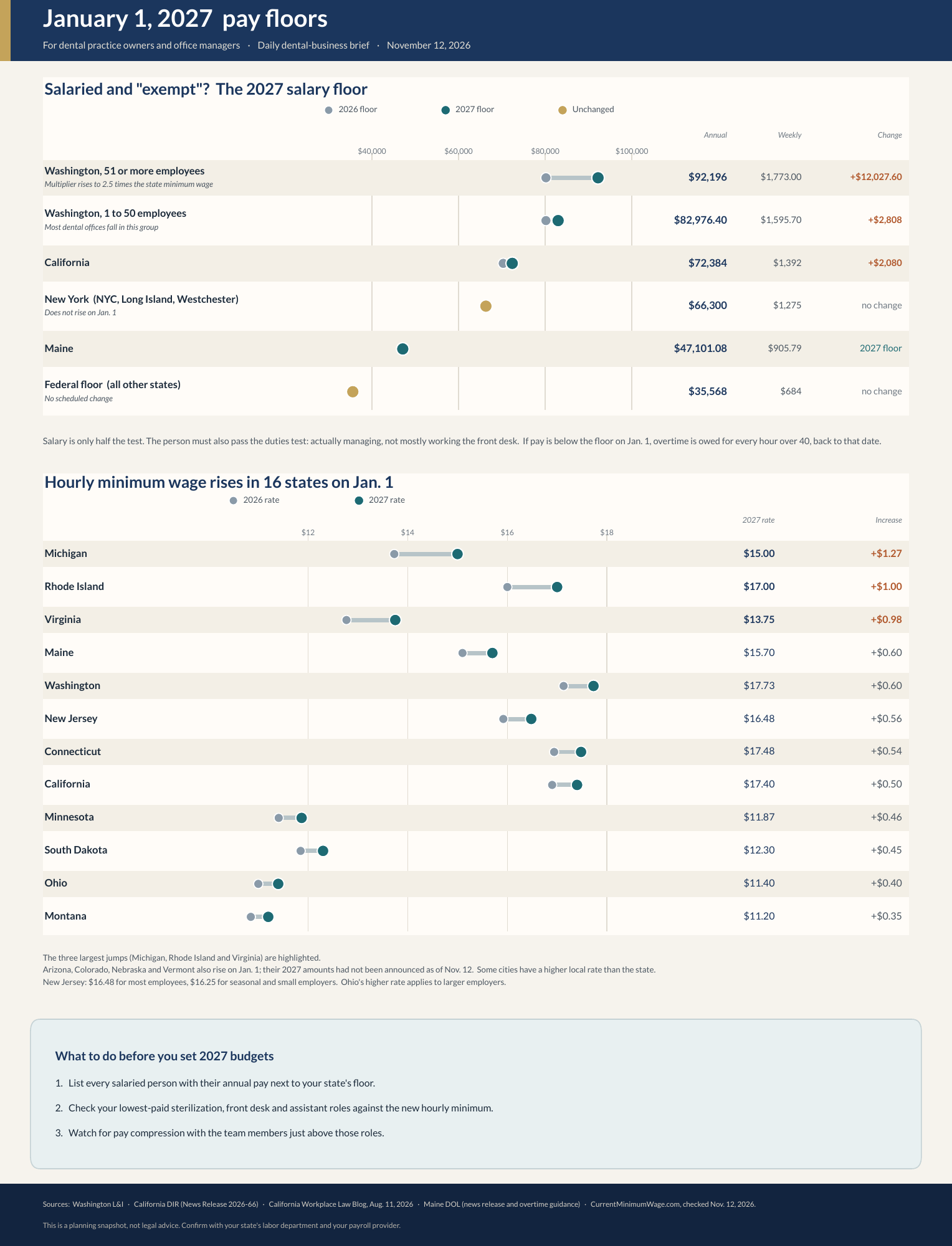
In Washington, the floor depends on how many people you employ. For a practice with 1 to 50 employees, which is most dental offices, the weekly threshold moves from $1,541.70 to $1,595.70, or $82,976.40 a year. For a practice with 51 or more employees, the multiplier rises to 2.5 times the state minimum wage, and the floor moves to $1,773 a week, or $92,196 a year, an increase of $12,027.60.
California's exempt floor moves from $70,304 to $72,384, which is $1,392 a week. Maine's 2027 floor is $47,101.08, or $905.79 a week. New York's downstate floor, for New York City, Long Island, and Westchester, stays at $1,275 a week, or $66,300 a year, and does not rise on January 1. In the rest of the country, the federal floor remains $35,568, or $684 a week.
A salary above the floor is not enough on its own. The duties test still has to be met. If someone is below the new floor on January 1, you will need a plan: raise the salary, reclassify the role, or change how overtime is handled. That is much easier to sort out now than in the first pay period of the year.
2. Check your lowest-paid hourly roles against the new minimum
Of the 16 states with a January 1 increase, 12 have already announced the 2027 rate. The largest jumps are Michigan, from $13.73 to $15.00, Rhode Island, from $16.00 to $17.00, and Virginia, from $12.77 to $13.75.
Other announced rates include New Jersey at $16.48, Connecticut at $17.48, Washington at $17.73, and California at $17.40. Arizona, Colorado, Nebraska, and Vermont have increases coming, but the 2027 amounts had not been posted as of November 12.
A few footnotes are worth a close look if you practice in those states. Some cities set a higher local minimum than the state. New Jersey's $16.48 is the rate for most employees; a lower rate applies to seasonal and small employers. Ohio's higher rate applies to larger employers. The chart has the full announced list.
If you have team members at or near the current minimum, run the new rate against your actual payroll before January 1 so the first checks of the year are right.
3. Watch for pay compression
When the floor moves up, it does not only affect the people who were below it. Someone who is already a little above the new minimum, or a little above the new exempt floor, can end up earning almost the same as a colleague who was just raised to meet it.
That is pay compression, and it is one of the reasons a January change can create tension that has nothing to do with the quality of anyone's work. If a raise for one role narrows the gap with the next role up, decide now whether that next role needs to move as well, and what you can afford.
Use the free chart
The one-page chart shows the 2026 and 2027 exempt floors side by side, and the hourly increases ranked by the size of the jump, with the three largest highlighted.
Download the free 2027 pay floors chart (PDF)
This is a planning snapshot, not legal advice. Confirm the final figures with your payroll advisor or your state's labor department before you change anyone's pay. Duties, local ordinances, and your own employment agreements all still matter.
The figures in the chart come from Washington State Labor and Industries, the California Department of Industrial Relations, and the Maine Department of Labor. The January 1 hourly increases are as compiled by CurrentMinimumWage.com, checked on November 12, 2026.
If you would like to talk through how these changes land on your overhead, I am happy to walk through it with you. Schedule a consultation